Tech blog
Models are commoditising - is value now shifting to the scaffold?

Where does the majority of the value in AI flow when the model itself becomes a commodity? Have we reached the point where LLM capabilities are sufficient for most tasks? If so, what does this mean for the future of AI, and where does the value shift?
The battle for raw model capability is fading
AI companies have competed primarily on raw model capability for the past few years. Valuations were set by it, conferences were built around it, and leaderboards reshuffled every few months. That competition, however, is fading. Not only because raw model intelligence is stalling, but because it has become adequate for most of the work: leading labs are close in quality, and their models are becoming effectively interchangeable (opens in new tab).
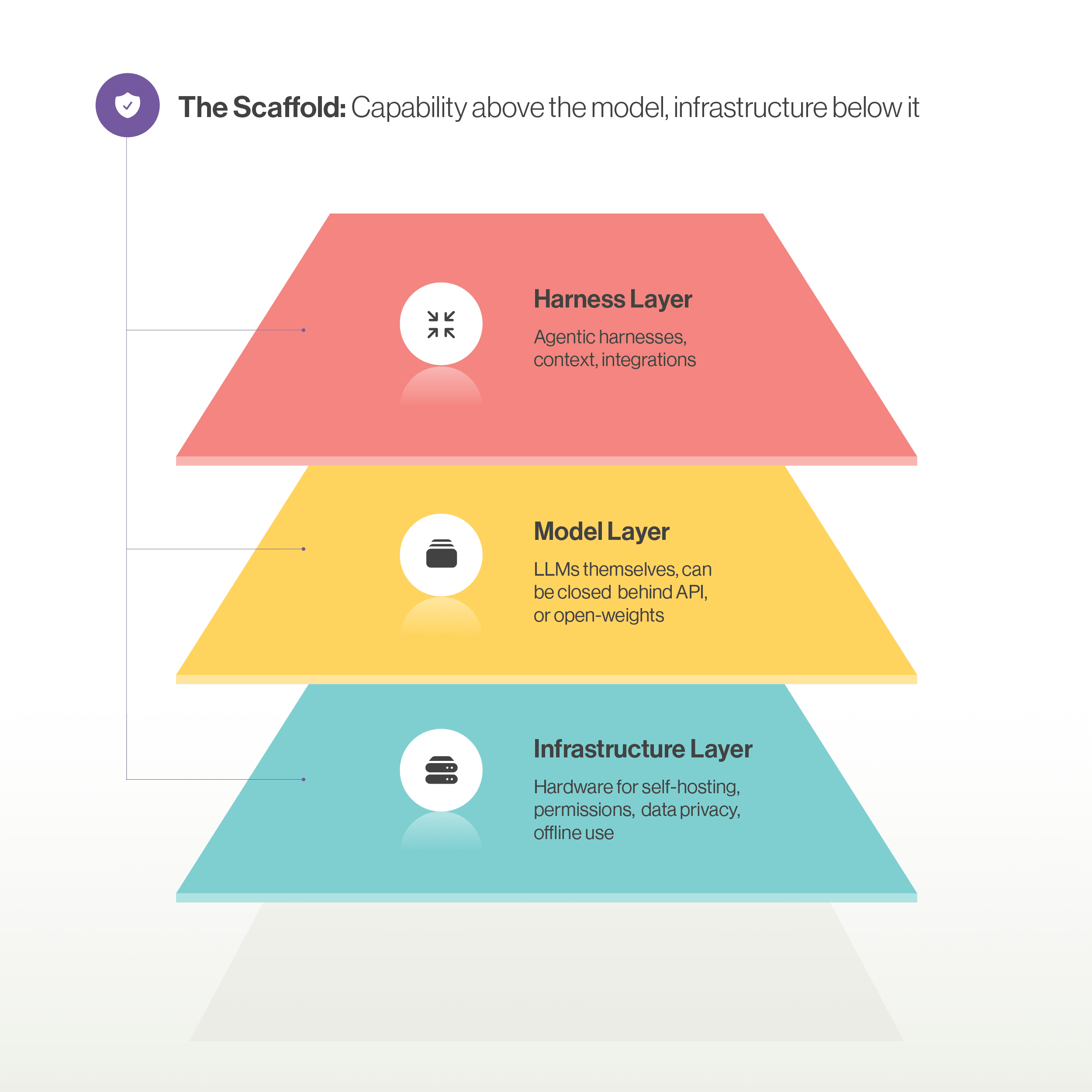
Frontier-class capability (i.e. today’s top-tier performance) is available from several providers, and open weights (models that are free for anyone to download) are just months, if not weeks, behind. The value is now moving into the adjacent layers, both above and below the model. This is the “scaffold”, meaning:
- The integrations it can reach
- The context it's connected to, and how that context is managed
- The data it's tuned on
- The infrastructure it runs on
- The permissions it's given
The model itself is becoming a commodity, and the system around it is the product.
Why scaffolding, not bigger models, drives competitive advantage
As a software engineer, there's an enormous difference between how I used to work with AI one year ago compared to how I use it today.
In 2025, I'd use browser chatbots like ChatGPT to refactor a method, make a UI tweak, or fix a small bug - tasks that would save me maybe an hour or two. Today I exclusively use agentic harnesses like Claude Code to plan, design, and implement features from requirements to final product. Creating new components, performing deep restructures, or implementing new complex features now takes days instead of weeks.
This agentic harness is just one part of what I refer to as the scaffold - the layer of abstraction that sits on top of the LLM, giving it the ability to search and retrieve information, execute a command, reason over the results, and decide what to do next. It’s what turned a model that answers questions into one that completes tasks.
Refactoring a function in a chat window was already possible with a capable enough model. The inflection point came when harnesses were built around the model, closing the loop between reasoning and action. This is a defining example of how improving the system built around a model, instead of the model itself, has significantly advanced the capabilities of AI. Admittedly the models themselves have also improved drastically since agents arrived, but raw capability alone would have counted for far less had the model stayed inside a chat window.
The same story is playing out beyond software engineering. Enterprises don't just want a smarter model - they want one that knows their internal policies, compliance rules, conventions, and can act inside their systems rather than just describing what to do next.
None of that comes from a bigger, better model. It comes from the scaffold: what data it can reach, what tools it can call, what context it's given, and importantly, what context it's not given. And unlike raw capability, which is converging across labs, the scaffold is where real differentiation still lives - it's specific to a company or workflow in a way an LLM isn't.
Are LLMs becoming a commodity?
This same pattern has played out many times before: something arrives scarce, novel and expensive; the technology spreads, interfaces standardise, and eventually buyers can't distinguish the offerings on anything but price. When one layer of a stack commoditises, the value flows into the adjacent layers.
In the 1980s, when IBM's PC design was cloned into a low-margin commodity, the profits didn't just vanish - they went one layer down to Intel, who made the chips, and one layer up to Microsoft, who made the operating system. The same pattern played out in the early 2000s when fibre optic cables became cheap and abundant, and the bulk of the value flowed up, to the companies who built on top of that cheap bandwidth, such as Google.
Is AI now undergoing the same commoditisation arc? The interfaces and conventions are standardising, and for a large share of workloads (programming, summarising transcripts, writing documents), the models have already overshot the requirement, which is the classic precondition: once a product is good enough for what most buyers actually need, further improvements stop commanding a premium.
We've already seen how a large portion of the value from the AI investment boom flowed into companies like NVIDIA, AMD and Samsung, who sit one layer below the model and provide the hardware it runs on. Will the same happen to companies that sit above the model, such as ones that provide specialised scaffolds that are built to fit specific industries or workflows?
How open weights and local models are accelerating AI commoditisation
If models are becoming a commodity, how do the economics change when that model suddenly becomes open, or when it becomes small enough to run locally?
Open-weights and self-hosted models are accelerating the commoditisation of the model layer. In doing so, they’re revealing that the layer below the model - the infrastructure, compliance, and data residency - is also part of the scaffold. While the layer built on top of the model enhances capability, the layer below enhances permission and control.
When a model's weights are free to download, a closed model provider can charge no meaningful premium for intelligence at that tier. And as more models reach that tier, the two become interchangeable for a growing share of tasks.
An open model can be run anywhere: on a company's own premises, in a private cloud, inside a jurisdiction that never sees the data leave. For a bank or a government, that isn't a small win - it's frequently the only option that's legally viable. A frontier model behind an API is off the table the moment the data it would touch can't leave the building.
Similarly, as our phones and laptops adopt more AI features that can transcribe our calls and read our emails, will we favour the highly capable models running on remote servers behind closed APIs, or smaller adequate models that can run locally, offline, without any data leaving our device? Does this mean that more value will flow into consumer electronics companies that build hardware capable of running local LLMs?
Smarter AI models or better systems around them?
None of this is to say that the quality of a model doesn't matter at all. Products like agentic harnesses would be far less useful if we were still using LLMs from one year ago, and there's a dramatic difference in output when using Claude Code with Haiku compared to Opus.
However, for an increasing share of workflows, model capability has already proved to be more than adequate. The question now is whether AI companies will keep charging a premium for bigger, smarter models, or whether the value will shift to the infrastructure, tools, data, and integrations built around them.
Will LLMs become a commodity that companies can build dedicated systems around? And perhaps to frame this differently - do we want more intelligent models? Are models like Kimi K3, Fable 5 and GPT-5.6 Sol not already capable enough, when given the right context, tools, and permissions? Should we focus our energy on purpose-built systems that integrate AI into manufacturing, healthcare, energy and transport - or on building bigger, smarter, more intelligent models?

Leonardo Phithak
Software Developer
26 August 2026
Subscribe
to our monthly newsletter for our latest expert content.