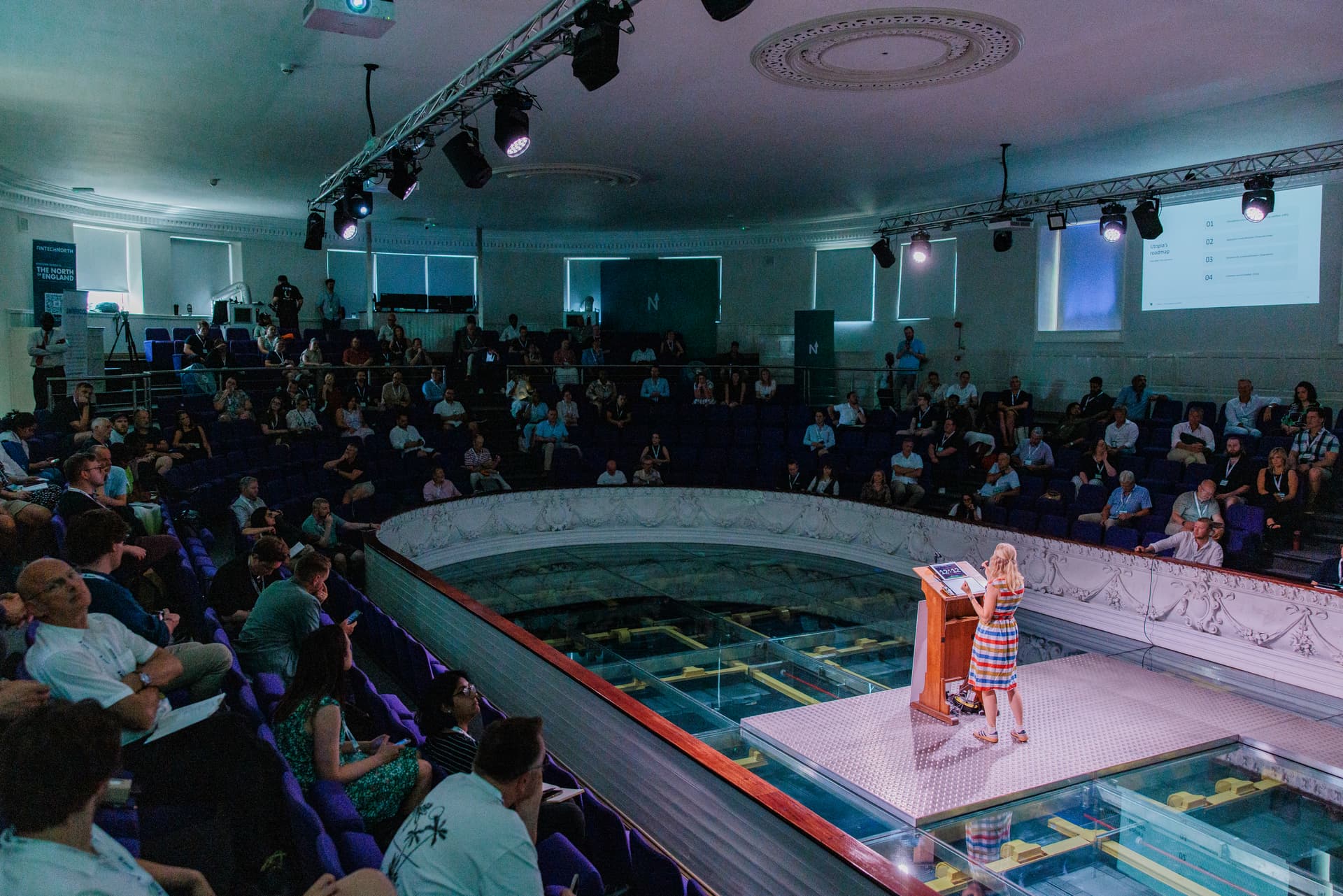
Written version of a talk given at TINtech Data Jam 2026 by Tim Benjamin, June 2026
1. The generation ship dilemma
Once upon a time, it was the future. Say 2030. Humans have invented a spaceship that can cross the distance between stars. They decide to make the journey…
It takes the spaceship 100 years to reach the new world. Several generations. But five years after the spaceship leaves, technology advances, and another ship is launched.
This one only takes 10 years to get to the new world! Disappointing for the people on the first ship when they finally arrive.
This represents a dilemma. Put yourself in the position of those inventive humans in 2030, with the chance (but not certainty) of new technology coming soon. Should you launch? Or should you wait?
There is no right answer, but
it’s a useful dilemma to encourage thinking (opens in new tab). The good news is that you’re not on an obsolete spaceship. But on the other hand, we face exactly this dilemma today in deciding whether to invest in AI initiatives.
2. The AI investment dilemma
Think about working systems built a short time ago, already redundant because the technology has moved on (new models, new AI approaches…) – a waste.
Invest now and your solution may be overtaken by new technology. But if you wait, can you be sure that new and better technology will arrive? If it doesn’t, will you miss the opportunity? How long will you wait?
If you can’t wait, and if you can’t not wait, what should you do?
3. Build for productivity?
One solution would be to build for productivity. Take an existing process and use AI to do it faster or cheaper. Back-office or BAU work – nothing risky, an easy target.
What could possibly go wrong?
It’s a trap, unfortunately.
Problem 1: What’s the payback profile? This is exactly the form of the “generation ship dilemma”. With this kind of approach, the payback time usually exceeds the useful life of the project, due to production edge cases, slow adoption, extra training, and more. There’s the relentless march of commoditisation, SaaS vendors springing up with a better version of your solution at a fraction of the price. It’s a bet against Moore’s Law.
Problem 2: Where do the returns accrue? It’s an uneven picture. For example, in a call centre, there will be experienced staff and junior staff. Productivity gains are likely to be greater, proportionally, with the junior staff. The gains are hard to predict. If it’s a small ROI overall (as is likely with a productivity play), it’s therefore risky, and may even turn out to be net negative.
Problem 3: What’s the effect on the expense ratio? Back-office productivity or efficiency “savings” are notoriously hard to see in the expense ratio (or in unit margins or P&L in other kinds of business), if they translate at all. Take Gartner’s case study1 into the large roll-out of Microsoft 365 CoPilot. The number of licensed users rises encouragingly over three months. But a graph of active users struggles to rise above background noise levels, except for a curious spike in month two. Statistics are gathered: 14 minutes have been saved, per person, per day. There’s a reported 80% rise in “digital dexterity”. How does any of this translate to the expense ratio?
And what happened in month two, that brief spike in active users? It was a training session!
4. The Productivity Trap
I call all of this the Productivity Trap. The problem – we need to invest in AI, amid uncertainty over timing and potential returns. The trap is to treat business-as-usual as an AI investment opportunity. BAU belongs to continuous improvement: small, cheap, predictable steps, adopting better tools gradually. Investment expects a step change and a significant, measurable payback. The trap lies in thinking that AI investment in BAU escapes the problem (in fact, exposure is greatest here).
The consequences are patchy, minimal, or invisible ROI, leading to increased scepticism from leadership, which leads to scaling back of current work and resistance to making future investments.
And we are seeing this – stories of 90% of POCs never making it into production, few people reporting significant ROI even when initiatives successfully scale, despite several years now of sustained investment into AI.
But I think there’s a way out of this situation.
5. Transformation
Organisations seeing strong returns use AI to do things that were previously impossible or uneconomic. They have invested in change, not just in technology. Newer, better technology may arrive, but investing in the change rather than merely technology offers a solution. In a word, “transformation”.
Think about horses for a moment. Suppose you have a horse at home, you use it to get about. Someone comes offering a new kind of hay that is easier for your horse to digest, and may allow it to run for a little longer each day. Do you invest in that hay?
Someone else comes, offering a new kind machine that allows you to travel much faster than a horse, over much greater distances, and for much longer. Now do you invest in that new machine? This is the motor car, of course.
6. The Transformation Test
I propose a simple test that you can apply when weighing up AI investment decisions. Ask: was this thing possible before, or impossible? If it was impossible before, but possible now, then this is an opportunity for transformation, and you should consider the case. Otherwise, do not.
There are at least two kinds of transformation that apply here.
First, changed economics. Desirable work, previously, was too expensive to be worth doing, no matter how efficiently or productively done. AI changes the economics, and the work becomes viable for the first time.
Second, changed capability. The desirable work, previously, was impossible for a human being to do, at any price. AI makes it possible, changing the capability.
7. A real-life example
We did some work in ophthalmology – eyes (opens in new tab). The problem was to gather and analyse millions of high-definition retina images, unifying hundreds of different formats and data sources, then detect and correctly classify potential signs of disease, all while ensuring sound data lineage and governance in a complex regulated environment. This was highly desirable, but impossible for even a skilled human team to analyse and compare over 20 million images, or to automate this conventionally.
AI made this possible – a change in capability from “impossible” to “possible”.
The result was faster, cheaper, and more effective diagnosis of eye disease than is possible by human experts. Earlier detection and treatment for patients, and preventable eye disease avoided.
Takeaways
Invest in transformation over productivity. Avoid the Productivity Trap.
If AI is only being deployed to make an existing process (BAU) faster, the return will probably erode before you capture it.
Apply the Transformation Test to AI initiatives (“Was this thing possible before, or impossible?”) For a quick “Monday Morning” action:
Pick one aspect of your product, service, or process that’s you’ve always wanted to change.
Ask your team what it would look like, if it didn't exist yet and if you were designing it from scratch (with AI as a given).
Apply the Transformation Test – capability or economics opportunity, or a productivity trap?
Revisiting the “AI investment dilemma” again, to finish. Should you invest now? Or wait for better technology? If you can’t wait, and can’t not wait, what do you do?
You should apply the Transformation Test to new ideas. If you identify Transformation, then yes, you should consider investing now.
Invest in the change, not just the technology.
¹ Gartner, Gartner Data & Analytics Summit 2026 London Presentation, “Value Is Trapped: Unlocking AI ROI Through Organizational Change”, Frances Karamouzis, 11-13 May 2026